PatsFans.com Menu
PatsFans.com - The Hub For New England Patriots Fans

WR Speed

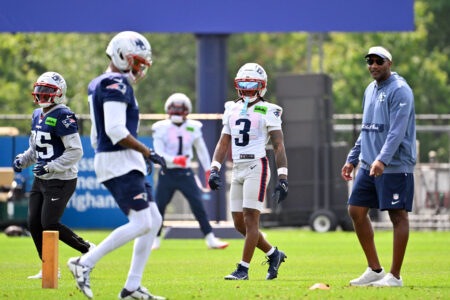
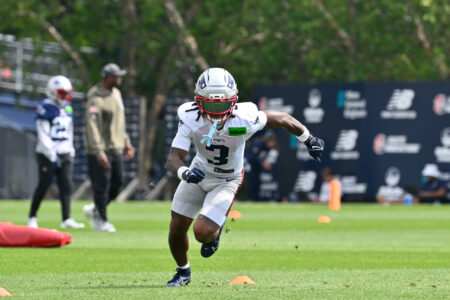
I think the real difference is between timed speed and playing speed. It's one thing to run a 4.4 in shorts and a t shirt, and another to do it in a full uniform and pads. Then you have to take into account all of the football factors, leverage, separation, tracking the ball etc... Williams demonstrated that he had those abilities last season, and will get better with more experience. Defenses have to respect his speed or get burned, and ultimately that's what he adds to the unit as a whole. Yoo ooo u want to force defenses to have to defend as much area as possible, that opens the field up for everyone, and that space creates more opportunities for the offense.
Exactly. Except that I think Williams has not yet conclusively demonstrated that he has all the necessary abilities. That’s why his place on the squad is still an open question, with some indications that it may not be as solid as we would like. There still seems to be some question about his route running, perhaps leverage and separation. That’s what makes things interesting, as how much defenders having to respect his speed might help his separation is part of the questions remaining to be answered.

One of my questions in starting this thread was how much more do defenders have to respect his speed at 4.40 than the 4.45 of Palmer? Or the 4.44 of Pop Douglas? And intuitively it seems that whatever respect they give Pop’s 4.44 will help his separation on cuts and moves, so does that help Pop more than Williams even if Williams gets more respect for his speed? It’s a nice multi-variable situation.
 
One word: Ochocinco. Ochocinco was fast but could not read a defense.

In McDaniels' offense, the receivers need to read the defense and run the correct route to be where the QB expects them to be when he releases the ball. Drake Maye is in graduate school this summer learning how to call the right route tree based on what the defense shows him. The receivers then need to adjust to what's called at the line that will give them the advantage and leverage they need to be where the ball is going.

Vrabel is pushing the pace of the offense to look more like 2011 and 2012 when the Patriots averaged over 80 offensive plays/game. The raw speed of the receivers becomes less important than being in the right place at the right depth to draw the coverage to places on the field that opens up lanes or soft spots.

This group of receivers, so far, looks like an excellent group to get good at this in 2026. Even the slowest guys like Mack Hollins become great targets if everyone is doing their job in this offense.
 
Playing speed is much different. Have you ever watched Jerry Rice pull away from guys? Guarantee a bunch of them were faster than Rice, he of the 4.71, maybe 4.6 on a good day 40 yard.

Wes Welker hit 4.65 in the 40. Jules hit 4.52.

One of the most important abilities is just out-knowing your opponent. If you understand what they're trying to do, you'll know how to counter it. That's how game tape nerds like those guys made their living. They could look at how their defenders were set up and shake them off using that knowledge.
Quickness is more important than speed.
Straight-line speed w/o short area quickness, is almost useless.
That's what made Tyreek Hill so great: he had both and knew how to use both effectively.
Too bad he's a scumbag human.
Also do you have moves? Shake n bake?
Jules had the shake n bake, the quickness and a bunch of other elite traits like his strength, toughness, intelligence and work ethic. So did Jerry Rice.
Straight 40 times are pretty worthless.
Edelman was a better WR than the vast majority of WRs who ran faster 40's.
 
A slightly faster 40-yard dash by 0.1 seconds means about 2 feet of separation. Which in the NFL equates to about a mile.
That's not necessarily true.
A fast wr needs to have the play strength and toughness to get off jams but also needs moves. Great moves are more of an asset to getting separation than strsight- line speed
 
That's not necessarily true.
A fast wr needs to have the play strength and toughness to get off jams but also needs moves. Great moves are more of an asset to getting separation than strsight- line speed
Yes, that’s where the factors like agility and lateral quickness and change of direction speed come into play to complicate the discussion. That 0.1 second or 2 feet gets lost in the shuffle pretty easily.
 
One word: Ochocinco. Ochocinco was fast but could not read a defense.

In McDaniels' offense, the receivers need to read the defense and run the correct route to be where the QB expects them to be when he releases the ball. Drake Maye is in graduate school this summer learning how to call the right route tree based on what the defense shows him. The receivers then need to adjust to what's called at the line that will give them the advantage and leverage they need to be where the ball is going.

Vrabel is pushing the pace of the offense to look more like 2011 and 2012 when the Patriots averaged over 80 offensive plays/game. The raw speed of the receivers becomes less important than being in the right place at the right depth to draw the coverage to places on the field that opens up lanes or soft spots.

This group of receivers, so far, looks like an excellent group to get good at this in 2026. Even the slowest guys like Mack Hollins become great targets if everyone is doing their job in this offense.
Ocho is a great reference. And a very good example of what we might still be concerned about with Williams, or any other fast receiver.

Interesting to hear that DeGennaro flashed today partly because of his speed. Another burner on the roster is always nice!
 
I'm always kind of surprised more weight isn't put on the first 5-8 yards of the 40 as most routes are developed around cuts at the 8-12 yard mark (unless you're a Mike Martz type HC).

Davante Adams had a "slow" 4.56 40 but a blistering 6.82 3 Cone (for comparison Steelers speed merchant Mike Wallace had a 6.90 and he ran a 4.33 40). Mike Evans ran a 4.53 40 at 231 pounds but had a crazy 7.08 3 Cone for his size. Both guys play faster but I think their quick twitch abilities really helped them on the field in doing a lot of the little things in regards to route concepts/designs that most typical fast speed guys struggle with.
 
I think what’s silly is trying to reduce complexity to simplicity. That’s why I hate analytics. But striving to do so generates useful insights, when taken in context. When taken out of context they’re not useful, or even misleading. I think the straight forty dash times are often taken out of context. Hence, this thread.

@Wozzy you make a good point, but I think there’s more to brain than just the binary can you play football or not. The brain has processing speed too, some players are better than others at that. There is a whole fascinating field called “Energy-maneuverability theory” developed by USAF Col. John Boyd to reduce dogfighting to science. In football it would apply to the difference between three cone and straight line performance, or why smaller players are usually more agile. A related theory, pertinent to brain processing, is called the OODA Loop (observe, orient, decide, act loop), which describes reaction time. In this context the question is how much does pure athleticism override reaction time?

The guys @Wozzy lists are all very smart players, gifted with excellence on the brain part of the equation as well as with athleticism. So they don’t really prove anything about athleticism being the sole important factor, or how much differences in athleticism alone matter.

Malcolm Butler had good brain and an average body, he survived a while. Once the try hard attitude disappeared because he was pissed Gilmore got the contract he thought he deserved Butler fell off a cliff.

Conversely Deion Sanders could give half effort tackling, make a mental error and still be the best CB of his generation. 4.2 speed is not overrated…. that’s foolish. Butler could never be Deion for that reason and that reason alone.
 
Last edited:
This hits a question I thought deserves its own thread: how important are small differences in the speed of WRs? And what are “small differences”?

Case in point: Williams forty time is listed as 4.40. Palmer, the new guy they just picked up on waivers, is listed at 4.45. Boutte is listed at 4.50. Just how big a difference is .05 sec, that’s five one-hundredths of a second, in a straight line forty yard dash?

When I asked Grok (full answer below) what were good NFL WR forty times both Williams and Palmer were in the “very good” but not in the “elite” range, with Williams right on the cusp of “elite”, just as Boutte was “good” but right on the cusp of “very good”. So how big a deal is 5/100ths of a second?

I thought it might be useful to look at all the WRs on the roster, to see what the range of speeds is and how they correlate with overall performance. Some interesting details emerged. Most surprising was discovering Williams is tied for second fastest WR on the roster! Also, half (6 of 12) of the WRs on the roster fall within .06 seconds of each other, between 4.44 (Douglas) and 4.50 (Boutte). AJ Brown is second to last in that group at 4.49, and Mack Hollins is a few ticks slower at 4.53. Here’s the entire breakdown:


And for sake of completeness here’s what Grok had to say. Should be some good conversational fodder in all this. We could even expand to discuss straight line speed versus change of direction. Can our slowest WR, Chism, overcome that by being better at changing direction? Let’s discuss. For starters I’ll say this makes me think forty times are overvalued, and that Williams isn’t particularly special. How’s that for throwing gasoline on a match, lol?
40 time is not the end all and be all for speed, but it's nice to know. I wrote a long post a long time ago about how ridiculously inaccurate the 40 time can be depending on which body parts hit both the starting and finish gates, especially compared to track and field fully automatic timing. We're talking up to more than a tenth of a second difference for the same run (? - I'm too lazy to find my very old post, but I did some serious number crunching).

For speed (not thinking about what's upstairs or side to side agility), what I care about is mph at different points of the route. Kendrick Bourne and Jakobi Meyers are thought to be slow AF based on their 40 times (initial 40 for KB), but at some point, KB was #1 and JM was 3rd in mph 1sec into their routes. Then there's top speed, which unfortunately, I'm a sucker for. KW had the 9th fastest top speed as a ball carrier last season (21.78mph). He def didn't have the 9th fastest 40 time in the NFL - He didn't even have the 9th fastest (or better) time in his Combine class. TreV was 6th (22.01mph with "only" a 4.43). Devin McCourty has the all time Pats top speed at 22.05mph with a 4.48 Combine 40.

As for Chism - 4.06 20yd shuttle and 6.77 3cone is really frickin' good. Welker had a 4.01 shut (which is elite jukeyness - my technical term). I'm guessing (read: hoping) he's got what it takes upstairs.

Side note: KW jumped out at me back during the 2025 draft based on the Senior Bowl practices/game Zebra speeds. He was top that year and 7th all time at 21.36mph. Guess who's 8th? Romeo Doubs at 21.25mph. Senior Bowl speed stats don't have to be as ball carriers, though, which makes a huge difference.
 
DM was really fast, they clocked him at 22 during a game, I remember them saying it.

There's more to it than running in a straight line, people get so hung up on that crap.... look at all the great WRS that have mediocre 40's.
 
Kyle Williams needs to watch Troy Brown tapes. This kid needs to be open and versatile. Play on Specials teams as a gunner, become our best punt returner and become a great short pass route runner and try defense! Make it so Vrabel would not even think of moving you. Tell coach Vrabel, I'll try it! He knows about being a Patriot means. You have brakeaway speed, God given. Use it to be on the football field!
 
This hits a question I thought deserves its own thread: how important are small differences in the speed of WRs? And what are “small differences”?

Case in point: Williams forty time is listed as 4.40. Palmer, the new guy they just picked up on waivers, is listed at 4.45. Boutte is listed at 4.50. Just how big a difference is .05 sec, that’s five one-hundredths of a second, in a straight line forty yard dash?

When I asked Grok (full answer below) what were good NFL WR forty times both Williams and Palmer were in the “very good” but not in the “elite” range, with Williams right on the cusp of “elite”, just as Boutte was “good” but right on the cusp of “very good”. So how big a deal is 5/100ths of a second?

I thought it might be useful to look at all the WRs on the roster, to see what the range of speeds is and how they correlate with overall performance. Some interesting details emerged. Most surprising was discovering Williams is tied for second fastest WR on the roster! Also, half (6 of 12) of the WRs on the roster fall within .06 seconds of each other, between 4.44 (Douglas) and 4.50 (Boutte). AJ Brown is second to last in that group at 4.49, and Mack Hollins is a few ticks slower at 4.53. Here’s the entire breakdown:


And for sake of completeness here’s what Grok had to say. Should be some good conversational fodder in all this. We could even expand to discuss straight line speed versus change of direction. Can our slowest WR, Chism, overcome that by being better at changing direction? Let’s discuss. For starters I’ll say this makes me think forty times are overvalued, and that Williams isn’t particularly special. How’s that for throwing gasoline on a match, lol?


Another way to think about it is the space that creates. A .05 lead can equate to about two extra footage of separation compared to someone who was .05 slower.
 
Yeah, but you're assuming a defender isn't equally as fast and athletic. I guarantee that in the NFL most physical advantages are negated by the guys on the other side. Guys like Darrell Green and Deion Sanders. Fans (and scouts, it seems) sometimes forget that receivers don't play in a vacuum. Then they compound that error by assuming the NFL is like college and high school. The NFL is no joke. When you look at how few players every year get jobs in the league compared to how many are made available, it's clear the NFL represents an elite group of athletes.

Nearly without exception, the biggest success stories every year are the guys who put in the mental work. The Patriots dynasty was built on guys like that. Troy Brown, Tom Brady, Welker, Edelman, Malcolm Butler, Stephen Neal, Tedy Bruschi, Dan Koppen, Kevin Faulk, Vrabel himself... they were all guys who studied their way into greatness.
 
DM was really fast, they clocked him at 22 during a game, I remember them saying it.

There's more to it than running in a straight line, people get so hung up on that crap.... look at all the great WRS that have mediocre 40's.
Mass (weight), height, length (wingspan), inline speed (forty), agility (shuttle/cone), explosion (jumping), strength (bench/weight room data)…. all measurables matter.
Do some fans overrate forty times in a vacuum… for sure. But a great forty time paired with great accompanying measurables is what a scout is looking at… along with brains and football smarts.

Randy Moss was tall, long, explosive, had good agility for a tall guy and was really football smart… but his speed on top of these things made him dominant.

In a league full of fast people, Moss was the fastest… and by chance you ran with him, he could out leap and out stretch you.

There’s alternative versions of this where agility for example was the defining trait. Look at Stephon Gilmore for one, he was fast and had all the measurables, but what made him unique was at 6 feet tall he had absurd agility, he had the quickness of a much smaller player. His 3.94 shuttle and 6.61 cone were absurd for his height.

Measurables and speed aren’t all that matter, but they matter a lot.
 
If you watched Williams in college, he looked faster than 4.40 flat. In fact, you can tell Williams was very disappointed in his 4.40 time at the combine. Imagine being disappointed in 4.40 ? It must mean you’ve probably timed faster than that in other runs.

If you saw the TD vs Tampa, he was flying. Nobody was gonna catch him. That is what he gives your offense. I feel that Vrabel gets it, they need his explosiveness to keep the defenses honest. He may be WR 5 right now, but he will get key snaps.
 

PatsFans.com LinkHub

𝕏 / Tweet
X.com: Maye Threw Behind Kayshon Boutte, Nearly Picked Off
Twitter
twitter.com · by Ian
1d
𝕏 / Tweet
X.com: Cardinals Training Camp Lowlights
Funny Videos
twitter.com · by Ian
2d
𝕏 / Tweet
X.com: Jeremiah Franklin Release Makes a Lot More Sense (CJ Dippre Returns)
Patriots News
twitter.com · by Ian
3d
📰 Article
youtube.com - The Patriots Tried Not to Score on Purpose: Goal Line Gamble
Patriots Videos
youtube.com · by Ian
3d
📰 Article
youtube.com: How the Patriots STOLE a Possession Every Game
Patriots Videos
youtube.com · by Ian
3d
𝕏 / Tweet
twitter.com
Uncategorized
twitter.com · by Ian
3d
𝕏 / Tweet
X.com Mike Vrabel on Jacas
Patriots News
twitter.com · by Ian
4d
𝕏 / Tweet
X.com: John Hannah SI Cover
Patriots Photos
twitter.com · by rkarp1
4d
Patriots Have Too Many Receivers, and Some Tough Decisions
MORSE: Notes & Analysis of Patriots Training Camp – Day 12
Vrabel Hints at Potential Celebration for 2001 Patriots Team
Vrabel on Patriots’ Special Teams Ace’s Injury: ‘Unique Role’ Complicates Return
Mike Vrabel Provides Injury Update on Patriots CB Carlton Davis
Drake Maye vs Tommy DeVito: Maye Comes Up Short in Patriots’ Blue-White Scrimmage
TRANSCRIPT: Mike Vrabel Press Conference Transcript 8/7
MORSE: Notes & Analysis of Patriots Training Camp – Day 11
Patriots LT Injury Reveals Team’s Current Backup Plan
Drake Maye on Christian Gonzalez Contract Standoff, His Own Patriots Future
Back
Top