- Joined
- Jul 3, 2010
- Messages
- 13,974
- Reaction score
- 21,155
Vrabel said that Chism and Hollins like to play games in the tub.And a fifth: Efton Chism Speed.
Registered Members experience this forum ad and noise-free.
CLICK HERE to Register for a free account and login for a smoother ad-free experience. It's easy, and only takes a few moments.Vrabel said that Chism and Hollins like to play games in the tub.And a fifth: Efton Chism Speed.
Exactly. Except that I think Williams has not yet conclusively demonstrated that he has all the necessary abilities. That’s why his place on the squad is still an open question, with some indications that it may not be as solid as we would like. There still seems to be some question about his route running, perhaps leverage and separation. That’s what makes things interesting, as how much defenders having to respect his speed might help his separation is part of the questions remaining to be answered.I think the real difference is between timed speed and playing speed. It's one thing to run a 4.4 in shorts and a t shirt, and another to do it in a full uniform and pads. Then you have to take into account all of the football factors, leverage, separation, tracking the ball etc... Williams demonstrated that he had those abilities last season, and will get better with more experience. Defenses have to respect his speed or get burned, and ultimately that's what he adds to the unit as a whole. Yoo ooo u want to force defenses to have to defend as much area as possible, that opens the field up for everyone, and that space creates more opportunities for the offense.
TMI.Vrabel said that Chism and Hollins like to play games in the tub.
I am just repeating what Vrabel said.TMI.
As long as they leave their kinks off the field they don’t matter.
For elite QBs single coverage is open.A slightly faster 40-yard dash by 0.1 seconds means about 2 feet of separation. Which in the NFL equates to about a mile.
Quickness is more important than speed.Playing speed is much different. Have you ever watched Jerry Rice pull away from guys? Guarantee a bunch of them were faster than Rice, he of the 4.71, maybe 4.6 on a good day 40 yard.
Wes Welker hit 4.65 in the 40. Jules hit 4.52.
One of the most important abilities is just out-knowing your opponent. If you understand what they're trying to do, you'll know how to counter it. That's how game tape nerds like those guys made their living. They could look at how their defenders were set up and shake them off using that knowledge.
That's not necessarily true.A slightly faster 40-yard dash by 0.1 seconds means about 2 feet of separation. Which in the NFL equates to about a mile.
Yes, that’s where the factors like agility and lateral quickness and change of direction speed come into play to complicate the discussion. That 0.1 second or 2 feet gets lost in the shuffle pretty easily.That's not necessarily true.
A fast wr needs to have the play strength and toughness to get off jams but also needs moves. Great moves are more of an asset to getting separation than strsight- line speed
Ocho is a great reference. And a very good example of what we might still be concerned about with Williams, or any other fast receiver.One word: Ochocinco. Ochocinco was fast but could not read a defense.
In McDaniels' offense, the receivers need to read the defense and run the correct route to be where the QB expects them to be when he releases the ball. Drake Maye is in graduate school this summer learning how to call the right route tree based on what the defense shows him. The receivers then need to adjust to what's called at the line that will give them the advantage and leverage they need to be where the ball is going.
Vrabel is pushing the pace of the offense to look more like 2011 and 2012 when the Patriots averaged over 80 offensive plays/game. The raw speed of the receivers becomes less important than being in the right place at the right depth to draw the coverage to places on the field that opens up lanes or soft spots.
This group of receivers, so far, looks like an excellent group to get good at this in 2026. Even the slowest guys like Mack Hollins become great targets if everyone is doing their job in this offense.
Malcolm Butler had good brain and an average body, he survived a while. Once the try hard attitude disappeared because he was pissed Gilmore got the contract he thought he deserved Butler fell off a cliff.I think what’s silly is trying to reduce complexity to simplicity. That’s why I hate analytics. But striving to do so generates useful insights, when taken in context. When taken out of context they’re not useful, or even misleading. I think the straight forty dash times are often taken out of context. Hence, this thread.
@Wozzy you make a good point, but I think there’s more to brain than just the binary can you play football or not. The brain has processing speed too, some players are better than others at that. There is a whole fascinating field called “Energy-maneuverability theory” developed by USAF Col. John Boyd to reduce dogfighting to science. In football it would apply to the difference between three cone and straight line performance, or why smaller players are usually more agile. A related theory, pertinent to brain processing, is called the OODA Loop (observe, orient, decide, act loop), which describes reaction time. In this context the question is how much does pure athleticism override reaction time?
The guys @Wozzy lists are all very smart players, gifted with excellence on the brain part of the equation as well as with athleticism. So they don’t really prove anything about athleticism being the sole important factor, or how much differences in athleticism alone matter.

40 time is not the end all and be all for speed, but it's nice to know. I wrote a long post a long time ago about how ridiculously inaccurate the 40 time can be depending on which body parts hit both the starting and finish gates, especially compared to track and field fully automatic timing. We're talking up to more than a tenth of a second difference for the same run (? - I'm too lazy to find my very old post, but I did some serious number crunching).This hits a question I thought deserves its own thread: how important are small differences in the speed of WRs? And what are “small differences”?
Case in point: Williams forty time is listed as 4.40. Palmer, the new guy they just picked up on waivers, is listed at 4.45. Boutte is listed at 4.50. Just how big a difference is .05 sec, that’s five one-hundredths of a second, in a straight line forty yard dash?
When I asked Grok (full answer below) what were good NFL WR forty times both Williams and Palmer were in the “very good” but not in the “elite” range, with Williams right on the cusp of “elite”, just as Boutte was “good” but right on the cusp of “very good”. So how big a deal is 5/100ths of a second?
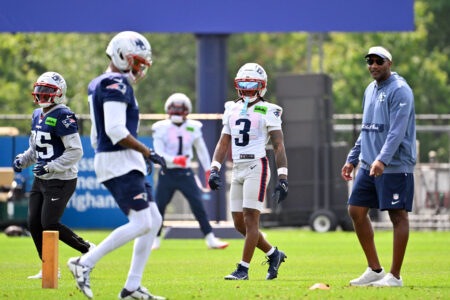
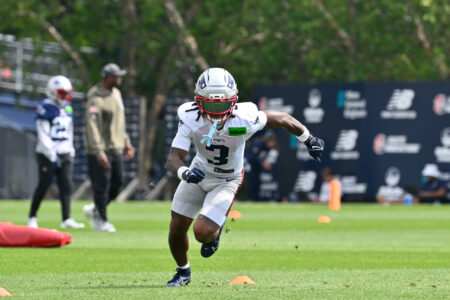
I thought it might be useful to look at all the WRs on the roster, to see what the range of speeds is and how they correlate with overall performance. Some interesting details emerged. Most surprising was discovering Williams is tied for second fastest WR on the roster! Also, half (6 of 12) of the WRs on the roster fall within .06 seconds of each other, between 4.44 (Douglas) and 4.50 (Boutte). AJ Brown is second to last in that group at 4.49, and Mack Hollins is a few ticks slower at 4.53. Here’s the entire breakdown:
And for sake of completeness here’s what Grok had to say. Should be some good conversational fodder in all this. We could even expand to discuss straight line speed versus change of direction. Can our slowest WR, Chism, overcome that by being better at changing direction? Let’s discuss. For starters I’ll say this makes me think forty times are overvalued, and that Williams isn’t particularly special. How’s that for throwing gasoline on a match, lol?
This hits a question I thought deserves its own thread: how important are small differences in the speed of WRs? And what are “small differences”?
Case in point: Williams forty time is listed as 4.40. Palmer, the new guy they just picked up on waivers, is listed at 4.45. Boutte is listed at 4.50. Just how big a difference is .05 sec, that’s five one-hundredths of a second, in a straight line forty yard dash?
When I asked Grok (full answer below) what were good NFL WR forty times both Williams and Palmer were in the “very good” but not in the “elite” range, with Williams right on the cusp of “elite”, just as Boutte was “good” but right on the cusp of “very good”. So how big a deal is 5/100ths of a second?
I thought it might be useful to look at all the WRs on the roster, to see what the range of speeds is and how they correlate with overall performance. Some interesting details emerged. Most surprising was discovering Williams is tied for second fastest WR on the roster! Also, half (6 of 12) of the WRs on the roster fall within .06 seconds of each other, between 4.44 (Douglas) and 4.50 (Boutte). AJ Brown is second to last in that group at 4.49, and Mack Hollins is a few ticks slower at 4.53. Here’s the entire breakdown:
And for sake of completeness here’s what Grok had to say. Should be some good conversational fodder in all this. We could even expand to discuss straight line speed versus change of direction. Can our slowest WR, Chism, overcome that by being better at changing direction? Let’s discuss. For starters I’ll say this makes me think forty times are overvalued, and that Williams isn’t particularly special. How’s that for throwing gasoline on a match, lol?
Mass (weight), height, length (wingspan), inline speed (forty), agility (shuttle/cone), explosion (jumping), strength (bench/weight room data)…. all measurables matter.DM was really fast, they clocked him at 22 during a game, I remember them saying it.
There's more to it than running in a straight line, people get so hung up on that crap.... look at all the great WRS that have mediocre 40's.
| 117 | 3K |
| 147 | 13K |
| 85 | 3K |
| 6 | 397 |
From our archive - this week all-time:
July 24 - August 8 (Through 26yrs)