


jmt57
Moderator
Staff member
PatsFans.com Supporter
2024 Weekly Picks Winner
2025 Weekly Picks Winner
- Joined
- Aug 13, 2005
- Messages
- 24,152
- Reaction score
- 19,953
Today in Patriots History
Steve Zabel
Steve Zabel
Happy 77th birthday to Steve Zabel
Born March 20, 1948 in Minneapolis; grew up in Denver area
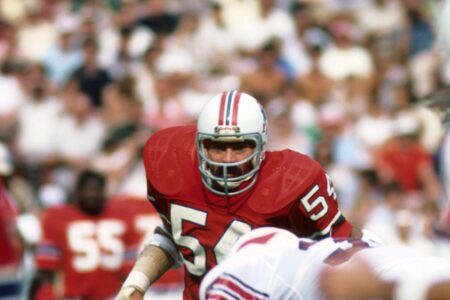
Patriot OLB, 1975-1978; uniform #54
Acquired in a trade with Philadelphia on July 15, 1975, for a 4th and 8th round draft pick
Pats résumé: 4 seasons, 49 games (44 starts); 222 tackles, 11 sacks, 8 fumble recoveries, 1 interception; 2 playoff games; Pats 1970s All-Decade Team
Steve Zabel was part of one of the greatest linebacking corps in franchise history. In the late 70s Zabel was on the outside, strong side, next to Steve Nelson. Sam Hunt was the other inside linebacker, and Steve King the other OLB. In 1976 the Pats defense ranked first in the NFL with 50 turnovers, as the team improved from 3-11 to 11-3, making the playoffs for the first time in 13 years. They should have won their first super bowl that year, if not for Ben Dreith.
Steve Zabel prospered as a two-way Sooner star half a century ago. Here's why two-way college football stars are 'more possible' in 2020.
In 1968, Oklahoma football coach Chuck Fairbanks made a choice that would dramatically change tight end Steve Zabel’s career. The Sooners started off slow despite a No. 5 preseason ranking, with a …
www.oklahoman.com
In 1968, Oklahoma football coach Chuck Fairbanks made a choice that would dramatically change tight end Steve Zabel’s career.
The Sooners started off slow despite a No. 5 preseason ranking, with a blowout loss to Notre Dame in the season opener and a loss to Texas two weeks later. His defense was struggling, so Fairbanks went to Zabel with a new challenge — he wanted him to play tight end AND linebacker.
“He said, ‘Steve, when you go play pro football, you’ll be either at tight end or at linebacker, and we’ve proven we can’t outscore people,’” Zabel said. “'We want you to play both ways.’”
The Sooners went on to finish the season 6-1 in the Big Eight with Zabel playing both ways.
Two years later, he was the sixth overall pick in the 1970 NFL Draft by the Philadelphia Eagles. Zabel played the majority of his 10-year NFL career at linebacker, where he started 95 games for the Eagles, New England Patriots and Baltimore Colts.
Class of 2015
Kurt Burris Induction Sponsored by University of Oklahoma Athletics Department Born in Nowata, Oklahoma, Kurt Burris grew up in a family of 11 children in Muskogee. He played center and linebacker …
oklahomasportshalloffame.wordpress.com
Steve Zabel was a standout high school athlete in Thornton, Colorado. He won state titles in both the high jump and pentathlon. Zabel was then recruited and signed by the University of Oklahoma.
He earned All-America honors as a tight end in 1969, and developed a reputation as a versatile player while at OU. The Sooners utilized him at defensive end and as a punter. He helped the Sooners win two Big 8 Championships and earned All Big 8 honors.
Steve was the sixth player selected in the 1970 NFL draft by the Philadelphia Eagles. Zabel played 10 seasons in the National Football League. He started his NFL career as a tight end, but was moved to linebacker his second season and shined on defense. The New England Patriots acquired Zabel in 1975. His second season in New England was his best as a professional. He led New England’s linebackers with 88 tackles and was named the team’s most valuable defensive player.
1968 Photo of Oklahoma Sooners' Steve Zabel
Former Patriot Still Laments a Forgotten Playoff Scandal
He caught a few touchdowns his rookie season then moved to linebacker and stuck.
Steve recalls, “My first season as a pro was also the first year that they had Monday Night Football.”
Zabel re-joined his old coach, Chuck Fairbanks, in 1975.
By 1976 the New England Patriots were really good.
Steve Grogan had become the starting quarterback.
Russ Francis moved in at tight end.
Future Hall of Famer John Hannah played guard.
Zabel was that years defensive MVP.
“In ’76 we went 11-3,” he says. “As a matter of fact, we made it to the playoffs.”
They traveled to Oakland to play the Raiders in the first round.
But that team had a surprise waiting on their own home field.
“When we went out to play the field was sloppy, muddy, wet, and the grass was about six inches long.”
Zabel has a short highlight reel of great plays from his NFL career.
He only has one shot from that playoff loss to the Raiders.
It shows him sitting on the bench bending over in anguish, a reaction that still mirrors his feelings about what might have been of they’d played on a neutral field.
Steve says, “This Super Bowl is all about ‘Deflategate’ and what a deal that was. Maybe they ought to go back to 1976 and talk about Al Davis (Raiders owner) flooding the field to slow us down so they could go on and win the Superbowl. It was horrible.”
Zabel retired from pro-football in 1979. He moved back to Edmond and established a street ministry. He also invented a training device called the Tug which is used by football teams around the country.
“When I played for the Eagles, I played for three different coaches in five years and played four different positions on the field between offense and defense,” Zabel said. “It wasn’t a good situation.”
New England was different. He made 48 starts at linebacker in his 50-game career with the Patriots and played with tight end Russ Francis, guard John Hannah, quarterback Steve Grogan and linebacker Steve Nelson.
Zabel, who will be 58 in March, was a college star at Oklahoma and recently looked back on his illustrious career from his home in Edmond, Okla.
His most recent stop was at tiny Curry College in Milton, Mass., where he was on the coaching staff for four years.
“It was a blast for me,” Zabel said. “If I had it to do over again, I wouldn’t have waited so long to go into coaching. It was something new and exciting for me. It didn’t seem like a job.”
Even though he was some 1,800 miles from home, Zabel wasn’t alone at Curry College, coaching with Nelson.
“He was a terrific team player when we played for the Patriots,” Nelson said. “He taught me a lot about playing in the NFL. He played outside linebacker, and I played inside. We had to communicate really well to be able to play our best.”
Sept 26, 1976 at Three Rivers Stadium: The Patriots defeated the Steelers, who were favored by 14½, 30-27
The Tug
thetug.net
After spending 20 years pursuing various business ventures, he decided to return to the game he loves, and began his new career in football as the offensive coordinator for the Curry College Colonels in Milton, Massachusetts. During his four years with the Colonels, the team collected an impressive record of 36-4, including two consecutive NEFC Championships. The concept for the TUG was developed during Zabel’s tenure with Curry College, at first using old tires in a tug of war drill.
At OU, stick wrestling was a common activity that Zabel can only describe as “brutal”. In the NFL, a similar drill was common, only utilizing a towel. These activities in and of themselves were not the challenge, instead it was the competitive spirit that was pulled from the players. While at Curry College, Zabel developed a tug of war drill for his players using old tires.
The TUG, or “TUGGER”, was born to provide an outlet for safer, competitive training for competitive, athletic teams. It can be used as a weight sled, or it can be flipped like a tractor tire. Players can curl it, upright row it, press it, perform triceps work, and even use it as an anchor when doing sit ups or leg lifts. The Tug is currently being utilized by dozens of NCAA Division I football programs and countless High Schools.
Where are they now? LB Steve Zabel
"As a rookie tight end, I'd gotten kicked out of three games for fighting. And at the end of the year, they told me they didn't think I had the proper temperament to be successful on offense and wanted to move me to outside linebacker," Zabel says. "I jumped at the opportunity. My rookie year, I came into camp weighing almost 270 pounds. They told me they wanted me to get big to be a blocking tight end, and it really hampered my speed and agility.
"My second year, I came to Training Camp as an outside linebacker weighing 230 pounds. I gained all my quickness and speed back. It was a wonderful thing. I was all for playing linebacker, believe me."
"When I got out of football, I got into real estate development and the oil and gas business," Zabel says. "And then the economy in Oklahoma back in '84, '85 went to heck in a handbasket. So, I kind of had to start over and I got into telecommunications, and I did that for 20 years."
In the early 1990s, Zabel and a college teammate, Larry Bross, founded a nonprofit organization in Oklahoma City called City Care.
"We originally started out by feeding the homeless Monday through Friday mornings," Zabel says. "We got to the kitchen at 5 AM five days a week. As a matter of fact, the first day I showed up, I cooked 72 dozen eggs. We had about 350 people that we served."
That was just the beginning. In 1995, Zabel and Bross started a tutor/mentor program called Whiz Kids. It works one-on-one with approximately 1,000 students during the school year throughout Oklahoma City.
Former OU All-American and NFL player Steve Zabel found his life's work after football
Zabel will enter the Oklahoma Sports Hall of Fame on Monday, Aug. 3 because of his athletic prowess. He was a first-team All-American football player at Oklahoma — where he played tight end and lineb…
www.oklahoman.com
He and OU teammate Larry Bross founded City Care, which over the past 20 years has helped thousands of low-income families find housing, provided them with food and other resources and helped tutor young children through it’s “Whiz Kids” program.
Whiz Kids has more than 1,200 volunteers, Zabel said, and will serve more than 900 students during the upcoming school year. The goal with Whiz Kids is to break the cycle of poverty and illiteracy for low-income students between the first and sixth grades.





 instagram.com