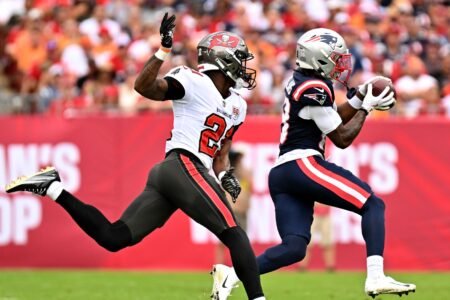
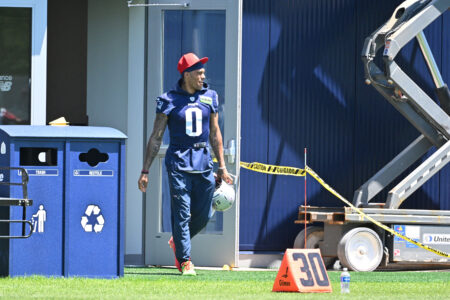
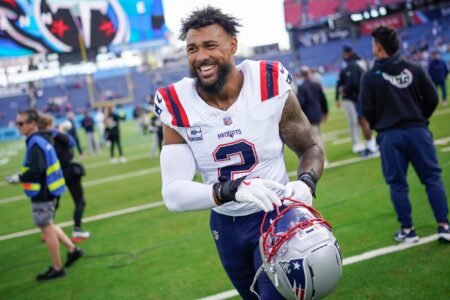
Because -- as with all those other moves -- when you look at the dynamics around the player, the likelihood of him being out the door is staring you right in the face. In Gilmore’s case, the factors are stacked up pretty high.
He’s carrying out a shadow-holdout. He’s 31. He never got on the field in training camp to show how well his surgically-repaired quad has healed. He’s got a cap hit in excess of $16M. He’s got a $7M salary. The Patriots are just $54K under the cap and want to sign Jamie Collins, apparently. In the 11 games he played last season,
he wasn’t close to the corner he was in 2019 when he was the DPOY. And as great as he was in 2019, he closed that regular season
getting devoured by Ryan Fitzpatrick and DeVante Parker in a must-win game.
The Patriots, through the first four weeks of the year, have learned that they are not up Poop’s Creek without a paddle in the secondary sans Steph.
Meanwhile, Gilmore had angled his situation as favorably as possible. Nobody wants quad surgery. But the injury allowed Gilmore to land on the PUP list. And when it was time to come off, he could have slow-played it for three more weeks. He could have come back after that time expired, made about $1M per game, gotten credit for the season and become a free agent.
I get the indignation I’m seeing and hearing over the lack of return the Patriots are potentially going to get. Getting something is better than getting nothing.
If the Patriots dealt him at the deadline last year, they'd have gotten something. They did not. So as it stands, Gilmore will have played five games post-2020 trade deadline all at a sub-Steph level and for a generous rate of pay since the team gave him a raise last year.
We can't be context-free on the analysis.