


Bella*chick
Addicted to the light
- Joined
- Feb 22, 2005
- Messages
- 10,510
- Reaction score
- 4,968
Registered Members experience this forum ad and noise-free.
CLICK HERE to Register for a free account and login for a smoother ad-free experience. It's easy, and only takes a few moments.

Ted Wells and crew apparently took 14 weeks to investigate bullying in Miami. Who the heck knows when this one will end.


Peter King
The recent statement that "one ball was 2 psi under, & the others were just a tick under" makes absolutely zero sense. ALL balls were down about 1.3 psi below the pressure to which they were set. We KNOW that all the Patriots' balls were set to 12.5 psi, therefore they ALL were reading around 11.2 psi. Which is NOT "just a tick under".

Physics can explain a drop of ~1 PSI, but we don't know that it needs to.
We don't actually know this.
That drop you cite assumes a certain drop in temperature. Without knowing the exact details of how the Patriots prep the balls, we don't know what the initial temperature of the balls was.
We also don't know how long it takes for the balls to reach thermal equilibrium with the ambient air. For all we know, it might take 12 hours.
All the speculation that's happened here is to explain what might have happened. Physics can explain a drop of ~1 PSI, but we don't know that it needs to.
In other words: it is possible that, as Rapoport reported, most of the balls were just under the limit.
As I said elsewhere, there are a lot of reasons why the balls would be as Rapoport reported them.

We don't actually know this.
That drop you cite assumes a certain drop in temperature. Without knowing the exact details of how the Patriots prep the balls, we don't know what the initial temperature of the balls was. We also don't know how long it takes for the balls to reach thermal equilibrium with the ambient air. For all we know, it might take 12 hours.
All the speculation that's happened here is to explain what might have happened. Physics can explain a drop of ~1 PSI, but we don't know that it needs to.
In other words: it is possible that, as Rapoport reported, most of the balls were just under the limit.
Can you point me to where you described your explanations?
__
In conclusion, having run the experiments, I am completely comfortable stating that I consider the issue settled within the likely extremes of initial & final values for temp & pressure.

Hey ct.
I disagree that there are a bunch of unknowns.
I disagree because I ran some tests.
I disagree. I believe that there is sufficient information available to make valid ESTIMATES of the actual conditions. And the rest of the unknowns can be covered with a reasonable sensitivity analysis.
For example, I believe that the following assumptions are justifiable:
1. Room temp in locker room: 71 - 76°F.
2. Internal air temp of footballs in locker room: 71 - 80°F
3. Pressure in balls in locker room: 12.4 - 12.6 psig ("reasonably accurate pressure gauge")
4. Dry bulb temp for last 15 minutes before half time: 48 - 51°F
5. Rain temp: 46 - 50°F
Using best case & worst case THEORETICAL calculations yield:
10.7 psig < P2 < 11.6 psig
Using the same best & worst case temps, along with the experimentally determined pressure lapse rate (0.06 ± 0.02 psi/°F) yields:
10.3 psig < P2 < 11.4 psig
Nope, I do know.
It was a component of the experiment I ran.
In mine, I exposed 3 official game balls 6to cold water (@ 48°F), then cold air (@ 50°F) for 70 minutes. I ran 3 duty cycles of water/air, just to look for a difference.
These cycles were intended to be a "reasonable simulation" of a ball's typical use. One play used, dried off,
i) 1 minute immersion in cold water, dry off with a towel, 9 minutes cold air. (7 cycles = 70 minutes)
ii) 1 minutes immersion, dry off, 4 minutes cold air. (14 cycles = 70 minutes)
iii) 7 minutes immersion, dry off, 3 minutes room temp (71°F) (7 cycles = 70 minutes)
The pressure drop over the course of the testing reached the same steady state level, which tells me that even the 1 minute water/9 minutes cold air had sufficient heat transfer to reach the steady state cold value (represented by the 7 minute immersion/3 minute room temp air).
The dousing exposure to cold rain & water guarantees a HIGH heat transfer between the balls & the cold water/air when the balls were cooling off.
Drying the balls off & sitting them in a warm room (with cold water soaked leather) and only convection as the heat transfer mechanism guarantees a LOW heat transfer when the balls were warming up.
A full 3 hours after concluding my tests, drying the balls off & sitting at room temp, the pressure in the balls was STILL in the low 11 psi range.
Theoretical physics can explain a drop of about 1.3 psi between 75°F & 49°F.
Experimental physics (at least in my tests) suggests a drop of 1.5 psi between those same temps.
I missed your explanation as to how this is possible.
The ONLY way that I see this to be possible is for someone to have been inflating the balls while they were cold.
Can you point me to where you described your explanations?
__
In conclusion, having run the experiments, I am completely comfortable stating that I consider the issue settled within the likely extremes of initial & final values for temp & pressure.
One factor that isn't needed to explain any further psi loss is that rain is often quite a bit colder than sea level air temperature (or warmer).
And another factor I haven't heard talked about, but one I wonder about is the strong cooling effect of evaporation. A wet football being spun at great velocity (60 mph or more) as its thrown just seems like it might have the potential to cool several degrees from my limited understanding of natural refrigeration techniques.
Belichick joked that Letterman should be a witness when the Patriots are interviewed next month. Next Month? Does that mean they aren't even talking to him until March? If so, set your calendars until July- that is probably when the report gets released.
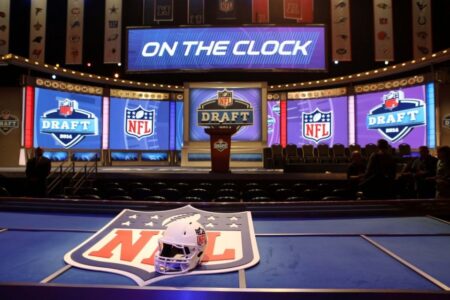
Edit: I wouldn't be surprised if they try to release the report close to the draft. That way, the imbeciles at the league office can quickly redirect the national dialogue.

Yeah but Goodell will look funny announcing the First Round in a wheelchair.Goodell's plan is to release the report right before the draft
He'll take a draft pick away
There won't be time enough for Kraft to appeal
Mission accomplished!
BM, can you point me at these reasons.
Thanks.
Pissah, I think if Goodell does take a pick, Kraft will get appeal time. But, I don't think they'll be any sanction because I don't think the NFL has enough, or anything for that matter.Goodell's plan is to release the report right before the draft
He'll take a draft pick away
There won't be time enough for Kraft to appeal
Mission accomplished!

| 47 | 5K |

From our archive - this week all-time:
April 3 - April 18 (Through 26yrs)