- Joined
- Sep 14, 2004
- Messages
- 2,494
- Reaction score
- 3,630
Registered Members experience this forum ad and noise-free.
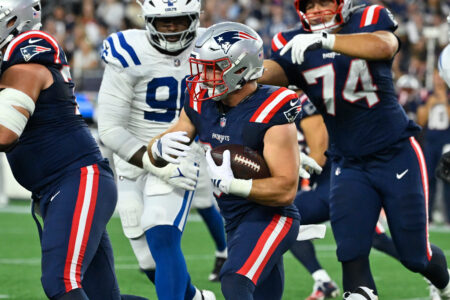
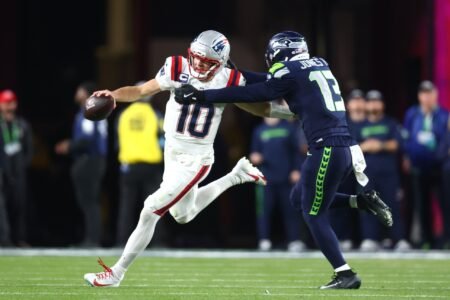
CLICK HERE to Register for a free account and login for a smoother ad-free experience. It's easy, and only takes a few moments.Popular with WHO?It's the Pat Patriot throwbacks for those two games. Bob absolutely refuses to bring back the popular "Bledsoe Blues".
I will always stan the soccer jerseys. They were different and looked cool.It's the Pat Patriot throwbacks for those two games. Bob absolutely refuses to bring back the popular "Bledsoe Blues".
Fans?Popular with WHO?
Pat Patriots w Red tops was always the bomb.
Popular with WHO?
Pat Patriots w Red tops was always the bomb.
False, at least as far as NE militiamen goes. The dominant color was red with prior Service militia because they considered themselves English citizens until 4 July. If they served in French-Indian, they likely had red from that.And they always lost wearing them too... so bomb is the appropriate word.
Plus, the British wore red, not the Patriots. The Patriots wore blue.
Last year coveted the "Patriots Rivalries Hoodie" however none were available, since then have picked up a couple of new hoodies so not interested any more.
However, they are available on the Nike website ($120).
New England Patriots Rivalries Collection Sideline Men's Nike Dri-FIT NFL Pullover Hoodie
Find the New England Patriots Rivalries Collection Sideline Men's Nike Dri-FIT NFL Pullover Hoodie at Nike.com. Free delivery and returns.www.nike.com
False, at least as far as NE militiamen goes. The dominant color was red with prior Service militia because they considered themselves English citizens until 4 July. If they served in French-Indian, they likely had red from that.
Blue was not institutionalized by GW until several years into war. I think same time as von Steuben, but unsure. Even then, most couldnt afford to buy new clothes, so blue was primarily an Officer color, I believe.
The source I captioned was directly from Nike, not the proshop.The Patriots Pro Shop sent an e-mail saying that the Rivalries gear was back in stock. I checked it because my daughter wanted a Rivalries winter hat last year and they were sold out after one game. Turns out "back in stock" did not mean what I thought it meant. Some game jerseys, a baseball hat and tee shirts were there, but not much else.
A. Portraits, particularly ones painted 20 years After the Event when legends and narratives creep into play, ARE NOT PHOTOGRAPHS.I see you skipped over that the British always wore red during the Revolutionary War. A simple Google search will show you ample evidence of their uniforms.
In fact, if you Google April 19, 1776 and look at the images of paintings made after the Battle of Lexington-Concord i.e. the start of the Revolutionary War, you'll find plenty of them showing the British in red and the Patriots dressed in anything they could put on quickly - grays, blues, whites and probably even reds. No matter what the Patriots wore, the British always wore red.
I also see that you skipped over my comment that the Patriots never won much when wearing those uniforms. I have no fond memories of any game with those on the field. When they wear a Super Bowl wearing throwback unis, I'll consider changing my mind on this.

Pre-Revolutionary War militia coats were often red, like this one worn by the Boston company commanded by John Hancock. “At the beginning of the war especially, red uniforms in American lines were not uncommon,” says Keagle.
Matching one’s mortal enemy isn’t just awkward; it could be downright dangerous. Pennsylvania cavalry wore uniforms nearly identical to their British counterparts, prompting Washington to complain:
Advertisement
“I could wish Colo. Moylan would put his Regt in any other Uniform than Scarlet, because I am convinced that many Mistakes and perhaps some fatal ones will happen from our Dragoons being cloathed in Red and Blue which is the same with the Queens Dragoons.”
Captured uniforms were valuable to the chronically under-equipped Continental Army. In 1776, John Paul Jonescaptured a year’s worth of winter clothing headed to the British army and sent it to American troops.
the Hessian troops in blue with their tall brass caps,” says Matthew Skic, director of collections and exhibitions at the Museum of the American Revolution.
From our archive - this week all-time:
August 22 - September 6 (Through 26yrs)