


Here’s what Mike Vrabel had to say during an appearance on The Greg Hill Show on WEEI for Tuesday, January 14, 2025.
How are you?
“Fantastic.”
Great to be back in the building?
“Oh, yeah. I mean, already, Eliot and I have been meeting here for a couple of hours and just trying to go through the roster and have a lot of meetings and get through the staff and the support staff and everything that’s critical and the scouts and get to know them and see where they’re going and how we can help and support them.”
You want us to start easy or …
“Go wherever you want to go.”
On the topic of Elliott, and this may not be the case, but it seemed like the case in Tennessee was that there became an issue when it came to you earning full roster control and wanting I’d like to be in that role in addition to the head coach role.
“No, we didn’t win enough games in Tennessee. I think that’s the problem. No, that’s never been an issue.”
Are you comfortable with this arrangement?
“Absolutely. I wouldn’t be here. I wouldn’t be here and I think that through the conversations and the interview process and the conversations over the weekend with Eliot, and with Robert and Jonathan and just trying to put a roster together and a program. To me, that’s the biggest thing. I want to try to put a program around our coaches, our support staff, our personnel department, our players, most especially, that people want to be a part of, that they’re proud of, that they invest time and energy in. We can start to see results beginning here in the offseason when we don’t have the players, and then when we have the players in April, that these guys are like, ‘Okay, I feel like what we’re doing is going to help me.’ We don’t want to waste anybody’s time, especially the players’ time. So this is all very important to me, and it’s all very calculated after having done it for six years in Tennessee.”
Mike, when you look at coaching, you’ve been in this business a long time. The most important position, it looks like you have covered in Drake Maye. How important is it now for you guys to make sure you put the right pieces around him, especially a free agency, where it looks like you guys have some money. When we think about that, elite wide receivers have done such a great job – look at your former player in A. J. Brown and what that means – what’s the thought process going in that direction moving forward?
“Well, again, we talked about this passer rating efficiency in which we throw the football. You don’t have to throw it 50 times. I think an interesting stat was I think the quarterbacks that attempt more than 50 passes a game have won 22% of their games other than Tom Brady, he’s won like 70% of the games that he’s had to throw for more than 45 times or something. If you don’t have Tom Brady, then you probably shouldn’t throw it 45 or 50 times a game.”
“That’s not the point here. The point is that when we throw it, which will be as many times as we need to, that you want to be efficient, that you want to have great completion percentage, which then leads to receivers, going back to the question about receivers, receivers that have great catch radius, that can create separation that are good against contested catches. Right? Because when you’re contested and PBUs go up in the air, then they get intercepted. Right? Now that leads to turnovers, which then changes field position and all these things. We have to focus on the line because I think that the best teams right now in the National Football League are the ones that still have the best offensive lines that are changing the line of scrimmage, protecting the passer, have versatility in a run game, can run a zone scheme, can run a gap scheme.
“Because I don’t think you can just major and just stay in zone, because teams that penetrate and disrupt the zone play, you got to be able to find ways to double and move gaps and change gaps and force them to move positions. With that being said, want to focus on some of those areas, offensive line. We’ll take a look and see what skill we have here at receiver and give everybody a new opportunity to come in. It’s a clean slate, decide who wants to be here by their actions, and then continue to evaluate.”
You brought up Tom Brady. Was the reporting accurate that he reached out? You said, ‘No, I’m already…I’m going to New England?
“Well, I don’t know if that was the case. Tom and I have had many discussions. I think we’re friends. We’re teammates. We’re friends. We’ve continued to talk throughout my career in coaching, his career as he played, and now his new transition. So we’ve talked and we’ll continue to talk, but this is the place where I wanted to be, and this is the place that I’m at.”
Would he have been a good boss? What’s his management style?
“I don’t know. I didn’t stick around long enough to find out in the conversation.”
Mike, I love what you said about culture yesterday and how building a culture, it’s important when you’re at your lowest. When you look at this team in particular, theoretically, how long will it take to build back a culture?
“Well, that’s all based on the players that are willing to invest and change behavior if it needed to be changed and how quickly they hold each other accountable, how close we become. I think we’re going to spend a lot of time in being very conscious of the relationships in the building. I’m new here and haven’t been here since 2008, and so I want to make sure that how can I help the support staff? But when the players come in, they have to know each other. The coaches have to know the players. There has to be a relationship there that’s built on trust and built on communication and trying to give the players exactly what they need.”
“I hate to put a timeline on it because I don’t know, that could happen quicker. That could happen. It may go into training camp, and you need to go through training camp. Training camp is essential to build a team and going through practice and staying with each other for a lot of hours. Sometimes you get in arguments in training camp. Sometimes there’s fights, sometimes there’s things that happen, but you’re all doing it just to continue to build a team.”
Do you find that being a coach and seeing from your time playing to Tennessee to now, there’s been a change in the way in which the player is or acts? Because we talk about the millennial player right now and how different that is. Have you had to adjust your coaching style to make that better?
“Well, I just have to be conscious of the relationship and the connection of the players are coming in, what they need each day from me to be successful. So Jermaine [Wiggins] may need one personality and one style. Greg [Hill] may need something else, and I have to do a great job of understanding what each one of those players needs, how they respond best.
(Greg Hill:) I like to be coddled.
“That didn’t surprise me one bit. I can tell. I’ve known that for 20 years.”
(Greg Hill) I didn’t have to coddle you when I was kicking your ass all over the golf course.
“That is not going to happen. But I think that the system where we are getting a different player, and whether it’s the millennial or whether it’s specifically the college structure right now, which allows for transfer, which, again, they’re 18. Some of them make a decision that they wish they could have over and I like some of the idea of being able to go to another college, but there’s an NIL, they’re being compensated. So, I think that they come to our league, and not every one of them, but some of them do have to change some behavior, and we want to remove entitlement from our program. We want to make sure that we’re not entitling players to do something and earn something by not having worked for it.”
Wiggy and Ty Law on the show. Ty’s is going to be on at 9. Even [Rob] Ninkovich talk about the difference that there was in this locker room now and then with guys holding other guys accountable. Was that your experience?
“Well, that was my experience here. But that’s not like that every year. That’s hard to create. That’s a unique relationship that is between the players. Again, I have to try to, and along with Eliot and our personnel department, is bring in those types of players that will do that. Again, if they don’t, then that’s where I have to step in and protect the team.”
It’s a little bit easier when you got a guy like Willie Mac [Willie McGinest] walking around the locker room. [Laughs] I know my role, man. I know my role.
I think that’s great because I watched you and Tedy were on the Man of the Arena from years ago talking about that third Super Bowl Championship season. I thought it was so well done in how you and Tedy [Bruschi] were discussing that you were the ones that created the culture that some referred to as the Patriot Way or whatever, where you held each other accountable. It wasn’t about doing what was necessary. It was about doing everything you could and demanding that from the people that you saw walking to their car at 7:30 or whatever.
“You just wanted to be able to know that somebody else was as invested as you were personally, but also was willing to put the team first and make a decision that was maybe better for somebody else than it was for your own personal situation. Then as far as being on time, studying, learning, how hard you played, how hard you’re willing to communicate on the practice field, how well you came back in shape. We don’t have a whole lot of time with the rules that we have in the offseason. It’s critical that they come back in shape, and that’s a commitment that they make. We don’t have time to probably get back in shape once April starts. If we’re not ready to go come April, there’ll be some catching up to do.”
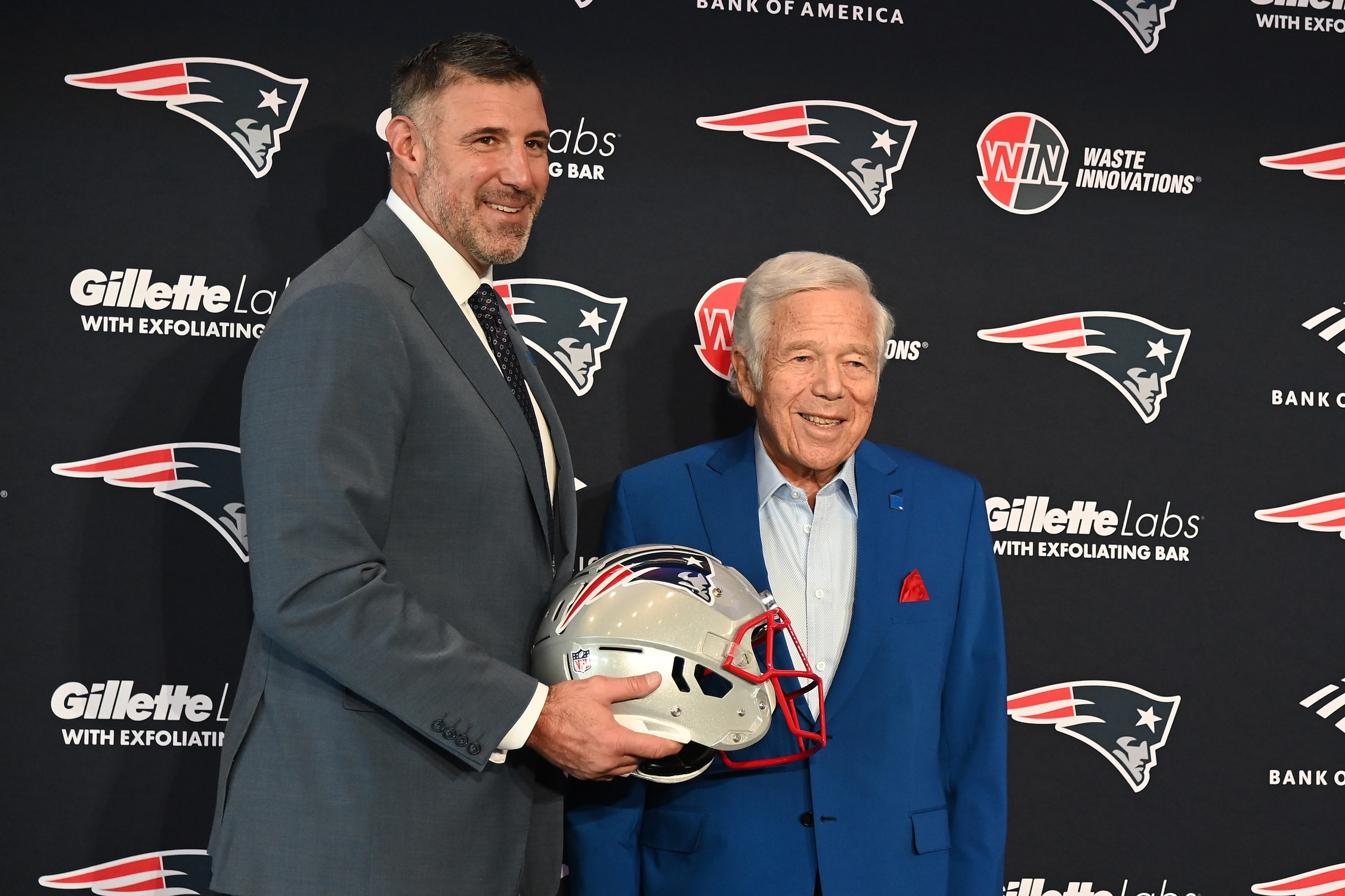
Mike Vrabel is our guest at Gillette Stadium for the first time as the head coach of the New England Patriots. I have been demanding that you be hired for this job for quite some time. Those who were opposed to it would argue that you’re a run-first and run-only guy.
“No, our best player was our running back.
That’s what I said.
“As you can see in Baltimore. We tried to structure the offense. We tried to build the offense around what we felt like was our best player and what was our strength. When we did have pieces around Derek [Henry] that we felt comfortable with, we threw it just as successfully as we ran it, and we were good in the red zone. I felt like we were creative. But you base whatever system and scheme that you have on the players that you have. I do think there’s a lot of versatility in not only myself, but hopefully the coaches that we hire.”
It seems like a different situation here when you look at what Drake Maye can do.
“Sure. And Again, we want to throw it as much as we can remain efficient and explosive. We want to gain as many players as we can that are tough to tackle, that you don’t have to throw the ball 50 yards downfield to create an explosive play. Now, we’ll have that ability, but you see around the league, some guys, you flip it out there, and they’re good a catch-and-run guy, and they’re hard to tackle, and you force defenses to tackle, you force secondary players to tackle. We want good guys that are good in space.”
“Again, then how skilled are we up front, how physical we are up front? But there’s still something to being able to run the football when you have to in short yardage situations around the goal line, to be able to control the pace of the game late in the game. When you play with the lead, these games, every year, they get closer and closer, just as how the league wants it, right? So everybody watches till the end of the game, and hopefully everybody has a shot, and how critical we can execute in the four-minute, two-minute situations. There is going to be an element that our physicality is going to have to play in and running the football is going to be part of it, but it won’t be the entire thing we do.”
Mike, one of the things that coming up in my career that I really respected from coaches, obviously, I have Parcells and Belichick, was transparency and putting the team above yourself. Based on a lot of your former players, they reiterate those same words about the respect level for a coach that makes sure every player understands their role and it’s team first. How do you make sure that you continue that coming to a team that might have had some issues and making sure that message is received loud and clear?
“The communication by me is critical that it is clear, it’s clean, it’s concise, and it’s direct. Like you said, the transparency. I’m always going to be honest with a player. They may disagree, but I’m also going to listen to them. I’m going to listen with the intent to understand them and not listen with the intent to respond. But I’m also going to treat them the same way they treat the team. If they treat the team really well, I’ll be willing to listen to anything that they have to say, any suggestions. If they don’t treat the team very well, if they’re not on time or they’re not in shape or they don’t play hard or they don’t study or they’re disrespectful to somebody in the support staff, hopefully they’re not here long. But if they are, I don’t have much to say to them or I’m not really going to take their input.”
Like you mentioned, I think the biggest thing is that average players want to be left alone. They want to come in, they want to pick up their check, they want to eat for free and go home. Good players want to be coached, and great players want to be told the truth. Every great player that I’ve been able to coach in the past six years has always come and said, ‘What do I need to do to be better? What do I need to do to be great?’ You tell them, and then they seek the truth, and then their job is to then handle the truth.”
What’s your timeline on hiring coordinators?
“No timeline. It’s the same thing we talked about yesterday. We’re not going to deal with timelines with injuries, or we’re not going to deal with hiring the staff, and when that’s going to be complete, it’s a long process. It’s one that will go out a few weeks. It could go out longer than that. It’s always delicate when you have teams that are continuing to play in the playoffs, potentially the movement that could occur with coaches on other staffs and related to their contracts. It’s just not as cut and dry as, ‘Hey, these guys are going to walk in tomorrow and we’re going to have a full staff.'”
Rob Gronkowski said your first call should be to Josh McDaniels.
“Yeah, I’m going to look at every possible candidate that I feel like can help us. We’re going to start that process today, this afternoon, and visit with some great coaches, and then we’ll see where things go. That’s all three phases.”
Is he on the list?
“Yeah, it’s a long list. Yeah, there’s a long list. I’ve had a relationship with Josh, and I’ve had relationships with other offensive coaches and defensive coaches that we’re going to interview and want to bring in here.”

How much pressure is there on the OC, though? When he brings up building a team around Drake, but making sure that he doesn’t have a revolving door of offensive coordinators throughout his time here?
“Well, this is a production business, so I think pressure comes with everyone that’s a part of this thing, whether you’re a player or whether you’re a coach. I think you have to embrace the challenge of just getting it right. That’s all we want to do is we want to get it right. If our players can handle a lot, we’re going to give them a lot. If they just need to get out there and get lined up and be able to snap the ball so that we’re going to avoid self-inflicted wounds, and we don’t want to have unforced errors. But if we can handle a lot and we can move and we can shift and we can motion and we can go play on the football and try to apply some pressure defensively, then those are all things that we’ll be able to do that I’ve done in the past with multiple coordinators.”
I don’t want to add any pressure, but you’re …
“You probably won’t be able to.”
But you’re here to save us, like the entire region. Are you aware?
“Yeah, I think we’re all aware of what our job is here to do.”
We have high expectations.
“And so do I. Yours aren’t higher than mine. I can promise you.”
On that note, you are a guy, obviously, the Jets, you were rumored with every opening that you were going to potentially have an opportunity to coach in the NFL for several teams. If you could dial it … to signify one thing, why you chose to come back and coach this Patriots team, what would it be?
“Well, I don’t think there is just one, but like I said, it’s the right time. It’s the right place with the right people.”
Wiggy brought up money. This team has over $130 million available salary-cap-wise.
“He’s always talking about money.”
(Jermaine Wiggins) That’s what happens when you don’t make a lot when you play.
I think that from the outside-
“401k.”
(Jermaine Wiggins) I got to wait till I’m 65. I’m on LinkedIn if you need a tight end coach.
“You look 65.”
(Jermaine Wiggins) I feel it.
If you’re hiring Wiggy, you missed this probably, but Wiggy was a head coach of the Brockton football team for one year.
(Jermaine Wiggins) Trying to get back to the kids.
Just one season.
“The boxes?”
(Jermaine Wiggins) Yeah, the boxes.
Just one year. But if you’re hiring…
(Jermaine Wiggins) Tight end coach. I’m on LinkedIn.
But were you able to in your discussions with-
“Only for option routes. You’re not coaching blocking.”
(Jermaine Wiggins) I mean, who really blocks nowadays, let’s be honest?
Were you able to get assurances from Robert [Kraft] during your discussions when considering this job that you are going to be able to spend that money?
“Yeah, I’m comfortable that Eliot and I are going to be able to find ways to add productive players, great people to this football team and that’s through the draft, that’s through free agency. So I’m confident that we’ll be able to have the resources that we need to go sign players within a limit. And we understand that free agency isn’t the only answer. It’s not 100%, as you all know, but it’s about adding the right players that we feel can help the team and that we’re comfortable with. Sometimes, if you don’t know them, you also don’t know what you’re going to get.”
Is this still a destination when it comes to free agents?
“Well, I think that we have to make it a destination. Again, I’ll tell you a story about free agency. When I got to Houston, they had natural grass in their dome, and they would wheel it out, and they’d cut it into sections. I’m like, ‘This is unique. What’s this?’ They’re like, ‘Well, we thought that the free agents would want to play on natural grass.’ I said, ‘The only thing free agents care about is green, and it’s not natural grass.'”
“There’s two forms of free agency. The one is trying to go out and maximize your earning potential and go for the top dollar. We see that early on in free agency, the first couple of days, maybe the first week. Then after that, I try to tell players it comes down to opportunity. If you want the best opportunity to go and be able to produce and contribute, and then that’s going to lead to then the next form of free agency, where then you could take advantage of the system in a year or two or whatever you sign with us. I was one of those players that coming from Pittsburgh and signing here, it was about the opportunity. It wasn’t about the dollars. That turned into being able to have those types of contracts as my career went on and the production increased and all those other things. We’re going to identify players at all different levels, and it’s a process putting it all together.”
Maybe if you provide free books on the sidelines, you might be able to get a certain wide receiver here.
“Yeah, we’ll see.”
Was he a big reader back when you guys were together?
“I think AJ is just trying to find ways to… I’m proud of his development, his personal development, and working on himself and working on controlling his… And getting back to center. Again, he’s a passionate player, and I love him to death, and I have a very close relationship with him.”
That book’s like number one on best sellers right now.
It is?
Skyrocketed, yeah.
“Good for him. Get some royalties.”
Wiggy wants the audiobook.
We have a special guest on the line.
Oh, we do?
Yeah. Billy in the car that wanted to celebrate …
Billy in the car? All right.
Let’s go to him. Let’s go to Billy from Chestnut Hill. Hey, Billy.
(Bill O’Brien) Hey, first-time caller.
“Long-time listener.” (Laughs)
It is Bill O’Brien.
“Andov-ah.”
(Bill O’Brien) Let’s go, Patriots. How are you doing, guys?
“You got any players up there yet, Billy? We find any players?”
(Bill O’Brien) We do, man. Hey, man, you going to come to our pro day, come speak to our team? I mean, I’ve already put my dibs in on that. So I’m excited for Mike. I’m excited for the Patriots, and it’s going to be awesome. No question. No question.
“Boston College is in good hands. They have great coaching staff, great leadership, got great facilities. They redid the facility a couple of years ago. It’s unbelievable. Billy, I can’t believe that I get to see. I can tell you some stories about working for Billy O. They call him the ‘Teepot.’ The ‘Teepot.’ He’d go off, and then 30 seconds later, he’d be like, ‘What’s wrong with you guys?’ Why are you looking at him? I’m like, ‘Billy, you just cussed out every one of us for 30 seconds, and now you’re looking at us like, What’s wrong?’ The teapot would just boil over, and then he was fine.
When he and Tom went at it, would you go over and calm them both down?
“He gave way to Tom. That was just Billy trying to look tough on TV.”
Well, I got to tell you, I don’t know if you saw the press conference yesterday, but Mike said a lot of nice things about you. You lived up to the promise to turn him into a head coach. So it’s something to be proud of.
(Bill O’Brien) No, I appreciate those comments. And like I’ve said several times this week, Mike’s a great coach. He was a great assistant coach. He’s been a hell of a head coach, and he’s exactly what the Patriots need. He’ll come in there and he’ll treat everybody in that building with great respect, and he’ll be fair with every player, but he’ll demand a lot. And the standard of how they practice and how they lift weights and how they run and how they condition and obviously how they play games and how they execute, it’ll be way up there. Everybody in the region is excited, and it’s great for the Patriots and great for Mike.
Any advice for him on navigating the waters around here? Any offices he should stay out of?
Avoid [Ben] Volin?
“Probably the one I’m sitting in right now. The media studio.”
Yeah, this is the one to stay out of. Unfortunately, you’re contractually required.
“You haven’t read my contract.”
All right, Bill O’Brien, we’ll talk to you again Thursday, but great to hear from you.
(Bill O’Brien) See you guys.
“See you, Billy.”
(Bill O’Brien) See you, Vrabes
Unfortunately, you got to do every Monday with us. Win or lose.
“You don’t have access to my contract.”
I mean, we’re going to be killing you when you go for two or something. Then you’re going to have to come in here and answer to it.
“I don’t have to come in here, technically. I can just call in in my office. I just have to do it. I don’t have to actually be here.
That is true. The man with the gold makes the rules.
Was that another thing when it came to Tennessee? I know you probably don’t want to dwell on the past, but just to clear up all this stuff. Was that another thing, too, where you disagreed with the analytics guys? You went for two that game at Miami or whatever, and they were all butt-hurt about it. Was that an issue?
“The game we won?”
Yeah. Where are you on analytics?
“High. I’m not sure where you get your information at. The analytics, we want to use as much information as we can to make great informed decisions in real time with real people. Things change. The weather, the backups, who you have in the game, how the defense is playing, how their offense is playing, have you stopped them? We’ll always try to use that information and excited to get with our staff here to see what they’ve done, whether that’s in acquiring players.”
“I look at analytics and I look at it in three phases. One, it’s in player acquisition. How do you apply analytics and the numbers and the data, play speed, estimated play speed, all these different things that you can use to evaluate players. That’s one area that we’re going to try to use it. The other one is in health and safety. How do we manage our players? What’s the workload? What’s their speeds? How often do they get to 90% of their max speed? You see all these numbers come out of the game.”
“Let’s say a player’s max speed is 20 miles per hour. Well, then we feel like at least one time between games, you should go 90% for a certain distance. You should run 18 miles per hour for X amount of distance. If you’re a gunner or a receiver or a player that does that. Like, we can see what they do in the game, and we want to make sure that they’re recreating that at least once during the season or once during the week. Then how we track player load management, how we construct practice, all these things that we’re going to use the data. Then the final piece of analytics is game management and risk ratio of going for it and all those different scenarios that you look at throughout the game. Those are the three buckets that, obviously, we’re going to always try to use analytics and then make a decision.”
Support Us: We're Currently Invisible in Google News
We need your help. A recent algorithm change has destoyed our traffic, and we need a quick moment of your time.
If you enjoy our content, please help us gain visiblity in Google's algorithm by adding us as a preferred source on Google News.
Click the button below and check the box next to "PatsFans.com"
Add as a preferred source on Google News
Ian Logue is a Seacoast native and owner and senior writer for PatsFans.com, an independent media site covering the New England Patriots and has been running this site in one form or another since 1997.
More Patriots News Headlines:

Vrabel Reveals Drake Maye’s Status For Patriots’ Preseason Game
By: Ian LogueThe Patriots' Mike Vrabel confirms Drake Maye will sit out Thursday's preseason opener against the Colts. Other QBs like Tommy DeVito will see action.
TRANSCRIPT: Drake Maye Press Conference 8/11
By: Ian LogueHere's the full transcript of what New England Patriots quarterback Drake Maye had to say following Tuesday's joint Patriots / Colts joint practice.

TRANSCRIPT: Mike Vrabel Press Conference 8/11
By: Ian LogueHere's the full transcript of what New England Patriots head coach Mike Vrabel had to say ahead of the team's first joint practice of 2026…
Notes From Patriots Training Camp: Day 13
By: Ian LogueAnalyzing Day 13 of Patriots Training Camp, Drake Maye and Tommy DeVito impress, while Carlton Davis and Will Campbell return to practice.
Patriots Part Ways With Another 2024 Draft Pick
By: Ian LogueThe Patriots released 2024 third-round offensive lineman Caedan Wallace, ending his tenure after injuries derailed his progress.