


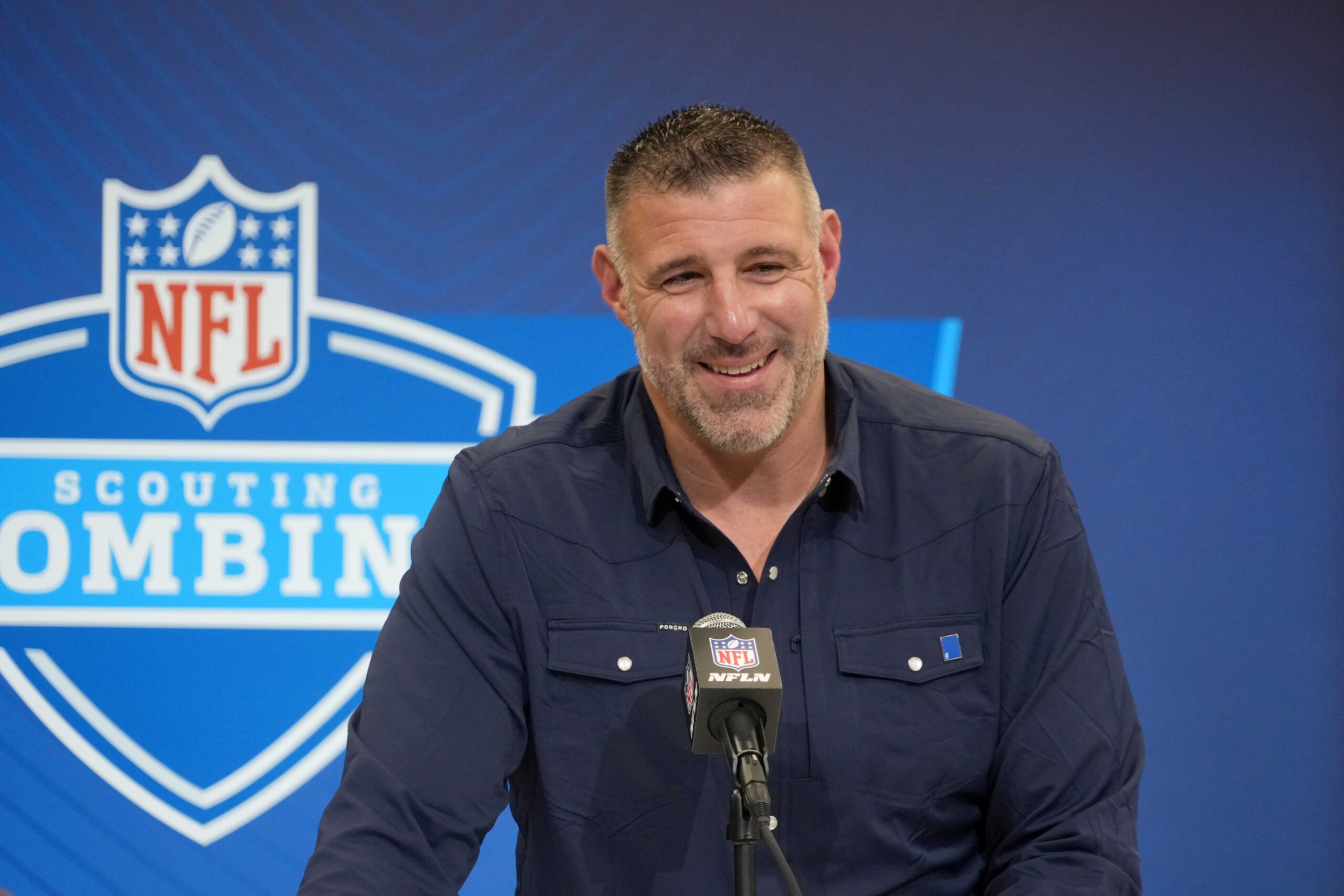
Here’s what New England Patriots head coach Mike Vrabel had to say during his pre-draft press conference on Tuesday.
OPENING STATEMENT
“Condolences to Betsy Hasselbeck, to Matthew, to Tim and Nathaniel. Obviously, their grandchildren. One thing I would say, talking about a successful man is someone that raises genuine, caring, thoughtful children, and that’s something that Don certainly did. Our thoughts and prayers are with the Hasselbeck family, former player here, former NFL player, rep, Union rep. Was always around town, when I was here, and got to have interactions with him and know his children. So I want to send in regards to them.”
“Been exciting here with the players being in town. It’s kind of unique with the draft prep and the timing of all this. So there’s certainly a great energy that’s around our building, and I want to continue to take advantage of that, to build on that, to grow that. Then excited about bringing great young players or great… Some of them, I think, with the COVID years are a little older now than what they used to be, but rookie players onto our football team through the draft and the post-draft process.”
On if they’ve received any calls from teams looking to move up:
“Well, I’d say it’s probably a little early for that, in my experience. Probably a little early for those conversations. A lot of those happen next week as we get a little closer to the draft. I think there’s still some prep and some managing that goes on and the coaches reports. So it’s probably a little early for some of those conversations to happen.”
On based on past drafts if he’s been someone where if he sees someone he wants, if he’s willing to trade up:
“Well, as far as manipulating the draft and the board and the value, and we’ve gone up and we’ve gone down in places that I’ve been. I think you’re just looking for the best value, and you’re trying to find players that are obviously talented and what we feel like are a great fit here for us and can help our football team at different levels. That happens at the top of the draft. That’ll happen in the middle parts. Then obviously, as you get towards the end, and there’s somebody that you want and you may get, or somebody gives you an offer, and you’re trying to get a little bit more draft capital.”
On high character guys in free agency and also good football players …
“I think that’s the most important thing, but yes…”
On if that translates to the draft, of he feels like because he brought in guys like Morgan Moses if maybe he can take a risk in the draft because he feels like the locker room …
“Well, we don’t want to take risks. I mean, I think we want to be aggressive. I think there’s a difference between taking risks and being aggressive and adding quality players and people to the roster. That will happen throughout player acquisition. I think that that’s something that’s important. But certainly the talent of the player has to be evaluated first, and then you go through a lot of different exercises and conversations and just try to figure out the type of person. But you can’t win and you can’t do what we want to do with just a bunch of good dudes. That’s not going to get it done.”
On the fact they had Abdul Carter in for a visit this week and what he’s seen from him on tape and what he learned from him during the visit:
“Well, we’re not going to discuss any of the interactions in the 30 visit, but I appreciate the knowledge of him being in here. I don’t think he took too many of them, but I would say that the tape is dynamic. There’s a lot of great qualities of a disruptive pass rusher, a very slippery, loose, sudden player, and it was a fun tape to watch.”
On what he’s hoping to accomplish in his first draft here in New England:
“The overall goal for the draft?”
For the draft class, yeah.
“I think it’s to add as many call quality players and quality people. You want to come out of it with some starters. You want to come out of it with some depth role players that can build, that strengthen the depth of the roster, the backup players, and the situational players. There’s just trying to find a fit for all these different players, where they are and what we see them doing. Then ultimately, they’ll come in and define their role. Then also in the post-draft process is trying to find some players that may have fallen through the draft that we have an affinity for or we feel like that we can develop. They have some traits that we can develop. That’s something that we believe strongly in as well once you get through the draft.”
On the fact he’s the one doing the pre-draft press conference and if that reflects that he has final say over the draft:
“No, I think that would just reflect that I was the person chosen to talk to you guys today. We’re excited about where we were in free agency, and Eliot and myself, and Ryan, and Matt [Groh], and Kim. I want to thank all of them for their efforts thus far, the scouts. I’ve always enjoyed sitting down with them, asking them questions. I mean, these are the men and women that have been around these players and at practices for the last two years and have seen them interact with their teammates. They’ve seen them practice. So I want to thank them. I want to thank the coaches for their involvement in the draft process and in free agency and evaluating them.”
“They’re getting ready for our players to come in and evaluating players. And as a coach, sometimes as an assistant coach, you evaluate players and you don’t end up getting the guy that you spent a bunch of hours evaluating and you might have liked, and that’s how it goes. Then you go to the next year. But we’re always trying to bridge that gap. I’m getting around to that between coaching and personnel. The longer that I do this, I always see that there’s players that the personnel side may really like, and there’s players that the coaching staff may covet for different reasons. My job and Eliott’s job and Ryan’s job is to bridge that gap and then to come up with a player that we feel like is best for our football team at that particular level. There’s been a great alignment, and we’re all excited about what we’ve been able to do in free agency. I’ve only … I think, reaffirmed that by seeing these guys in the building for the past just six days, but it’s been awesome.”
On if he feels like he’s going to have to be more aggressive rather than just letting the draft come to him:
“I don’t know if you can answer that. I think when we coach the football team, we ask the players to play. We want them to be aggressive, we don’t want them to be reckless. There could come a time, and I think there’s a lot of possibilities. There could be players that maybe we covet on the board that are there at a certain point, and we have to determine how far we are away from where that player is. That’ll be the same thing when you talk about trading back. How far do you want to trade back? Are there still going to be players there that you want at that particular level? I think we all have experience enough doing that, of going up, going back, and presenting … Every time you pick, there’s probably a, ‘Are we going to stick and pick?’ Or, ‘What’s the best offer that we have?’ That’s the role of the personnel staff is to kind of field those calls as they come in. Sometimes they’re good offers, and sometimes they’re not so good offers.”
On if he feels there’s a tackle in this class that would be worthy of taking at fourth overall:
“I think there’s some starting tackles that certainly will come in and start in the NFL. I think that that’s really what you start to look for, is impact players when you start picking that high, what they’re going to do for you, what’s the impact, what’s the position. You talk about premium position. And so then that’s where you kind of weigh all the circumstances and end up making that pick. So do I think that there are starters in this draft at left tackle? Yes, I do.”
On what the role of analytics is in this process and how does he balance what the numbers tell him versus what the scouts tell him:
“I think you rely on analytics to help you ask questions about what you see on tape. And not only ask questions, but answer and get them answered. And so I think that it’s a quick, very good snapshot of what you … you talk about durability, talk about height, weight, speed, measurables, time missed. Does that correlate to potential time missed in our league and the durability? So those are all things that they can give you. You can talk and you can look at certain positions analytically as it relates to the receivers and their drop percentage, or their ability to gain yards after the catch, or their contested catch, or how much separation yards. Then you go to the next position. Every position has a different analytical number or value that we would kind of look at. Then you go back and you watch the tape. When those things are highlighted, you certainly want to make sure that all those things are accounted for.”
On if there are other traits that translate more to success in the league, or if there are some where he thinks he can work them out when they get to that point:
“I think production. You start with production and see guys can make plays in the college level. Usually, that’s a good place to start. Then you would obviously just translate to certain things that edge rushers may have. You can look over the course of the last 10 drafts, let’s say, and see how those players did with certain scores and numbers. Some of them maybe were more productive maybe in the NFL than they were in college, that’s always one that I have to really focus on and ask, ‘Why?’ Maybe it’s a different scheme that maybe a guy is just rushing against a team that throws a bunch of RPOs and the ball’s out or not doing as… Where the passing game is a different passing game. I just go back to like Daneel Hunter. I always use this example. Watch him at LSU. He wasn’t very productive by numbers, but he tested well, and he had the height, the weight, and the speed. Certainly, when you look at what he’s done in the National Football League, it’s been very impressive. I always go back to that and make sure that if the production’s maybe not off the charts, then what else is there that we should be looking at that would translate to being successful in the National Football League?”
On if he’s gotten a better vision of what the top of the draft board might look like and who might not be on the board when it’s time for them to pick:
“No. I mean I think that we probably know as much everybody else and what gets reported. Tennessee’s not calling or Cleveland’s not calling, even though I was a consultant there last year. I haven’t heard their plans on who they want to pick. We’ll see as we get closer. If any of that information is available, we would love to have it.”
On what his philosophy has been in past drafts when it comes to drafting ‘best available’ as opposed to ‘position of need’ and how does that evolve round-by-round or year-to-year:
“Would love for them to align, having a need and having the best player be there. That doesn’t always happen. We certainly want to pick the best player as many times as we can. The player that we think at that point is the best player, and then we’ll figure it out. Maybe look at one position, and we may have some returning starters, or we feel like are starters, or there’s depth at that position. But to add premium players when available is something that you should probably always try to do.”
On when there are players that are graded similarly on the board what some of the tie breakers are that they take into account:
“Yeah, there’s the ranking system within the grade, right? When you start stacking players horizontally amongst their position, and then when you… vertically amongst their position, and then you start to look at it horizontally, that other players at another position with the same grade would rank higher. So maybe one player over here would lose out to another player over here, even though they’re on the same line, to kind of give you an idea. But then within the position, versatility, ability to play another position. Some of it, probably the testing numbers or what we feel like on film, but we try to go through, and that’s done and finished as far as the vertical process of where we see each player.”
On his first round picks in Tennessee and what lessons about what worked with those players are maybe those who didn’t, inform him on how he’ll approach this pick at #4 because it’s the highest pick he’s ever had to make:
“What kind of injury … We took a couple of guys with injuries that we thought were talented, and maybe what injuries as they fell in that value got to the point where we were comfortable taking it. I think that’s something that’s critical. What’s the ability for players to recover from one injury versus another injury I think is something that I learned. The impact that that player makes and demands on a ‘first-round pick’ I think, is something that’s just like the quarterback. It doesn’t have to be the face of the franchise, but everybody’s going to be talking about the first-round pick from the time that we pick them for as long as they’re here. So that kind of gets carried with them, and I think you have to have the attitude and the demeanor to handle some of that.”
On Stefon Diggs and how he’s seeing his recovery and how he’s doing with that:
“I think he’s doing everything like everybody else. He’s working hard, and I think he’s excited about being here and being a Patriot. He’s a motivated player. He’s a hungry player, just like everybody else that’s here and that’s working. That’s been the most exciting thing, I think, for me, is that they’re asking good questions. They’re into it. They know that some things are going to be different, and that change happens every year.”
On if Abdul Carter and Travis Hunter are gone when he selects at four if he knows what he’s going to do – he doesn’t have to say it – but if he knows what they’re doing:
“Well, we’re in the process of going through what everybody calls these simulations, and that’s been and will continue to be good exercises. It’s just running scenarios and what we would do based on those scenarios. To say that we have a definitive answer on those scenarios, no, but those are processes that are ongoing, and we’ll be done here shortly.”
On how important listening is to him when he hears the right things from these players and then he asks questions and hears it back, and how much it sinks in as he goes through the process:
“What sinks in the most with me is the first exposure to the second exposure to maybe the third exposure. It’s difficult. I think just … you don’t really know what you’re going to get in the first exposure, and I think that’s kind of not very fair either to be walked. Some of these guys don’t even know what room they’re in at the combine. If there’s not a Patriot logo somewhere in the room, it would be hard for them to every single time know which room they’re in because it’s just the hallway is tight and there’s a bunch of people out there and they get shuttled into a room. ‘Hey, this is so and so.’ I could tell them ‘I’m Tom Curran,’ and they’d be like, ‘Hey, nice to meet you.’ At that point, they just really… There’s a lot there. But then, the next exposure, they get a little bit more comfortable. And then the next exposure, whether it’s at Pro Day or the 30 visit, you start to see maybe who they are and kind of what their personality is.”
On whether or not he has any opinions or philosophies on running backs:
“Run where they ain’t. That’s what I tell the running backs.”
On whether he feels they’re worth a top 10 pick and if he has any thoughts on that topic?
“No, I think that that’s individualized based on how good the player is, how talented and what impact that he’s going to make, his ability to play in all three downs, his ability to catch the football, his ability to create mismatches, and obviously, what the team covets, I think that’s the most important.
On based on that idea, how many guys fall into that category based on where they’re drafting:
“Well, I think where we’re drafting, there’s a handful of guys. We’re not in the market for a quarterback, so that ought to eliminate anybody that throws the football. But I do think that there is certainly players that we covet at every level. I think that’s the thing that we’re finding as you go through. It’s a package. It’s a complete package. It’s about the player, it’s about the person. And most importantly, I think for me, the vision that we have for them and the impact that they’re going to make in the locker room and make in the community.”
On why they traded Joe Milton when they did:
“Well, we felt like his reps were going to be decreased as we worked through the offseason, and we felt like, just like every other decision, we’re going to try to do what’s best for the team. That’s the decision that we ultimately made. Excited to move forward with Drake and Josh. That’s going to be a tough one for me to continue to say over and over, just Drake and Josh. I appreciate it, guys. Again, I want to thank our scouts. I want to thank our personnel department for getting me brought up to speed in this process and our coaching staff. So thanks.”
(EDITOR’S NOTE: This transcript was done based on the available footage and is subject to typographical errors. If you spot anything, please let me know in the comments below.)
Support Us: We're Currently Invisible in Google News
We need your help. A recent algorithm change has destoyed our traffic, and we need a quick moment of your time.
If you enjoy our content, please help us gain visiblity in Google's algorithm by adding us as a preferred source on Google News.
Click the button below and check the box next to "PatsFans.com"
Add as a preferred source on Google News
Ian Logue is a Seacoast native and owner and senior writer for PatsFans.com, an independent media site covering the New England Patriots and has been running this site in one form or another since 1997.
More Patriots News Headlines:
Patriots News And Notes 08-30: The Depth Will Be An Issue
By: Steve BalestrieriThe Patriots' initial 53-man roster will reveal depth concerns. Gonzalez's stalled contract, and roster holes.

MORSE: Patriots Final 53-Man Roster Projection
By: Mark MorseProjecting the Patriots' final 53-man roster, this analysis highlights crucial cuts, potential waiver pickups, and a look at Eliot Wolf's draft strategy.
MORSE: Good, Bad, and Ugly as Patriots Embarrass Themselves in 37-13 loss to Browns
By: Mark MorseThe Patriots suffered an ugly 37-13 pre-season loss to the Browns. Analyzing the Good, Bad, and Ugly performances before roster cuts.
Patriots Postgame Notebook: Rough Night For the Defense, Vrabel Makes Interesting Revelation
By: Ian LogueThe Patriots' preseason concludes with a 37-13 loss, as Vrabel addresses defensive woes and Kayshon Boutte's trade. Kyle Dixon and Matt Haack impress.
TRANSCRIPT: Mike Vrabel Postgame Press Conference 8/27
By: Ian LogueHere's the full transcript of what New England Patriots head coach Mike Vrabel had to say following the Patriots' 37-13 loss to the Browns Thursday…